
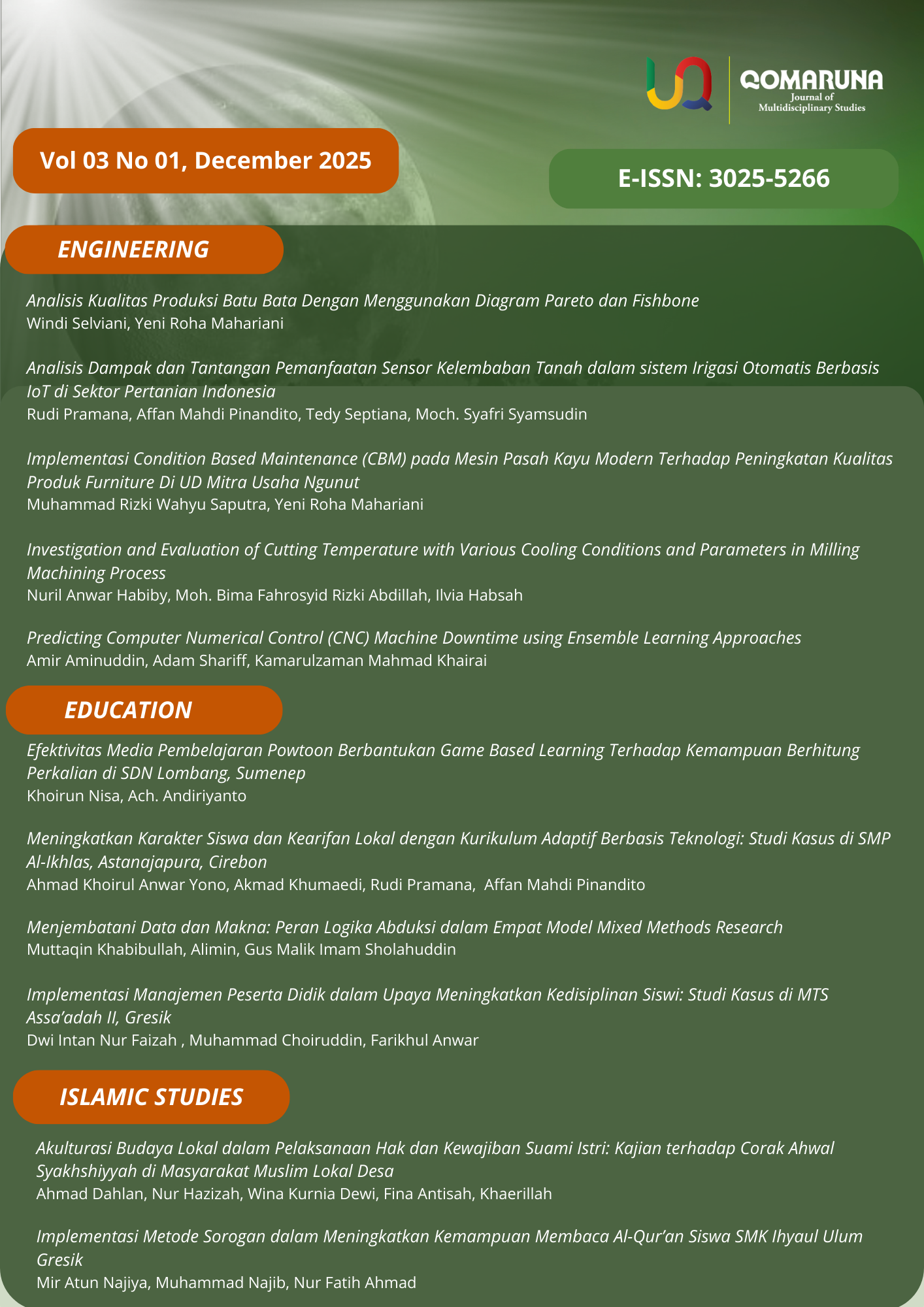
Akulturasi Budaya Lokal dalam Pelaksanaan Hak dan Kewajiban Suami Istri: Kajian terhadap Corak Ahwal Syakhshiyyah di Masyarakat Muslim Lokal Desa
DOI:
https://doi.org/10.62048/qjms.v3i1.108Keywords:
Acculturation of Culture, Ahwal Syakhshiyyah, husband and wife, Marriage, Rights and ObligationsAbstract
The implementation of the rights and obligations of husbands and wives in rural Muslim communities does not take place within a normatively sterile framework; rather, it is shaped by a dynamic interaction between Islamic teachings and deeply rooted local cultures. In practice, the norms of Ahwal Syakhshiyyah are not always applied textually as prescribed in classical fiqh literature, but instead undergo processes of interpretation and adjustment in accordance with the social realities of village communities. This study aims to analyze how local cultural acculturation shapes the implementation of spousal rights and obligations, as well as the patterns of Ahwal Syakhshiyyah application in the context of rural Muslim societies. This study employs a qualitative approach using a library research method, analyzing normative sources of Islamic law, statutory regulations, and relevant sociological and anthropological literature. The data are examined through content analysis and contextual interpretation to identify patterns of integration between Islamic legal norms and local cultural values. The findings indicate that local culture plays a significant role in shaping role distribution, decision-making processes, and the resolution of household conflicts. On the one hand, patriarchal patterns that position the husband as the primary authority figure remain evident; on the other hand, more balanced husband–wife relations have emerged, particularly in economic matters and family deliberation. These findings underscore that Ahwal Syakhshiyyah in rural Muslim communities functions as a living law that is adaptive and contextual. This study contributes to the development of Islamic family law by emphasizing the importance of a contextual approach to ensure that the values of justice, compassion, and household harmony can be realized without compromising the substantive principles of Islamic teachings.
References
Ahmadi, W. (2008). Hak dan kewajiban keluarga menurut Undang-Undang Nomor 1 Tahun 1974 tentang perkawinan. Jurnal Hukum Pro Justitia, 26(4), 371–390.
Ahyani, S. (2021). Kajian fenomenologi terhadap perubahan budaya akulturatif di Sumenep. Islamika Inside: Jurnal Keislaman dan Humaniora, 7(1), 44–78. https://repository.uin-malang.ac.id/8947/1/8947.pdf
Alena, D. (2024). Dampak terpisah jarak suami istri terhadap keharmonisan rumah tangga dalam perspektif hukum Islam (Penelitian di Kecamatan Babahrot Kabupaten Aceh Barat Daya) (Disertasi doktoral, Universitas Islam Negeri Ar-Raniry).
Ardiansyah, D., & Billah, A. A. (2023). Arus dinamis keadilan gender: Refleksi mendalam dalam perspektif Islam. IKTIFAK: Journal of Child and Gender Studies, 1(2), 82–89. https://doi.org/10.55380/iktifak.v1i2.622
Armia. (2015). Fikih munakahat. CV. Manhaji.
Faisal, N. F., Aisyah, S., Puyu, D. S., & Akbar, A. (2021). Otoritas istri perspektif akademisi hadis: Analisis resepsi eksegesis terhadap hadis R?‘iyah. Al-Izzah: Jurnal Hasil-Hasil Penelitian, 16(2), 87–101. https://doi.org/10.31332/ai.v0i0.3102
Fahrizal, F. (2022). Analisis yuridis pemberlakuan Undang-Undang Nomor 16 Tahun 2019 tentang perubahan atas Undang-Undang Nomor 1 Tahun 1974 sebagai upaya pencegahan pernikahan di bawah umur (Disertasi doktoral, Universitas Nusa Putra).
Hakim, A. (2025). Implikasi perbedaan usia dalam perkawinan terhadap hak dan kewajiban suami istri menurut hukum Islam. Al-Ahwal Al-Syakhsiyyah: Jurnal Hukum Keluarga dan Peradilan Islam, 6(1), 1–17. https://doi.org/10.15575/as.v6i1.44611
Hartawati, A., Beddu, S., & Susanti, E. (2022). Model mediasi dalam meningkatkan keberhasilan penyelesaian perkara perceraian di pengadilan agama. Indonesian Journal of Criminal Law, 4(1), 59–73. http://139.180.223.195/index.php/IJoCL/article/view/1551
Ikrom, M. (2015). Hak dan kewajiban suami istri perspektif Al-Qur’an. Qolamuna: Jurnal Studi Islam, 1(1), 23–40.
Ilyas, S. (2024). Dinamika hukum keluarga Islam di Indonesia: Antara tradisi, syariah, dan hukum positif. Jurnal Tahqiqa: Jurnal Pemikiran Hukum Islam, 18(1), 134–146. https://jurnal.stisalhilalsigli.ac.id/index.php/tahqiqa/article/view/290
Indanus, M., & Sugianto, S. (2024). Nilai-nilai keadilan dalam hukum adat dan hukum keluarga Islam pada masyarakat adat Kampung Naga Tasikmalaya. Jurnal Interpretasi Hukum, 5(3), 1276–1283. https://doi.org/10.22225/juinhum.5.3.10891.1276-1283
Kunratih, R. (2019). Dampak pernikahan dini terhadap keberlangsungan rumah tangga (Studi kasus di Kecamatan Gemawang). Jurnal Ilmiah Citra Ilmu, 15(30), 11–26. https://ejournal.inisnu.ac.id/index.php/JICI/article/view/69
Laksono, B. I. (2022). Tradisi ruwatan anak tunggal menurut Islam (Studi kasus di Desa Nambangan Kecamatan Grabag Kabupaten Purworejo).
Mamahit, L. (2013). Hak dan kewajiban suami istri akibat perkawinan campuran ditinjau dari hukum positif Indonesia. Lex Privatum, 1(1), 12–25.
Nafisah, D. (2019). Integrasi yuridis normatif dan psikologis untuk meraih cinta dan bahagia dalam undang-undang perkawinan di Indonesia. ADHKI: Journal of Islamic Family Law, 1(1), 149–160. https://doi.org/10.37876/adhki.v1i1.11
Pagar, P. (2015). Himpunan peraturan perundang-undangan peradilan agama di Indonesia. Perdana.
Pratama, A. R. (2024). Konsep perkawinan dan pembentukan keluarga sakinah dalam masyarakat adat Dayak perspektif hukum Islam (Studi kasus di Kelurahan Panarung, Kecamatan Pahandut, Kalimantan Tengah) (Disertasi doktoral, Universitas Islam Indonesia).
Republik Indonesia. (2012). Undang-Undang Republik Indonesia Nomor 1 Tahun 1974 tentang perkawinan dan kompilasi hukum Islam (Cetakan ke-10). Citra Umbara.
Sobariyah, L. (2020). Tradisi, gender, dan Islam: Studi tentang kesenian Bendrong Lesung di Lingkungan Gempol Wetan, Kota Cilegon, Banten (Tesis, Pascasarjana UIN Syarif Hidayatullah Jakarta).
Sulistiani, S. L., & Sy, M. E. (2021). Hukum adat di Indonesia. Bumi Aksara.
Syahrizan, M., & Siregar, A. H. (2024). Budaya patriarki dalam rumah tangga menurut perspektif hukum Islam. Bertuah Jurnal Syariah dan Ekonomi Islam, 5(1), 118–131. https://doi.org/10.56633/jsie.v5i1.787
Wutsqah, U., & Mukaddamah, I. (2023). Peran perempuan dalam membentuk ketahanan keluarga. Jurnal Inovasi Penelitian, 3(9), 7643–7652.
Downloads
Published
How to Cite
Issue
Section
License
Copyright (c) 2025 Ahmad Dahlan, Nur Hazizah, Wina Kurnia Dewi , Fina Antisah

This work is licensed under a Creative Commons Attribution-NonCommercial-ShareAlike 4.0 International License.
Works in this journal are licensed under a Attribution-NonCommercial-ShareAlike 4.0 International.