
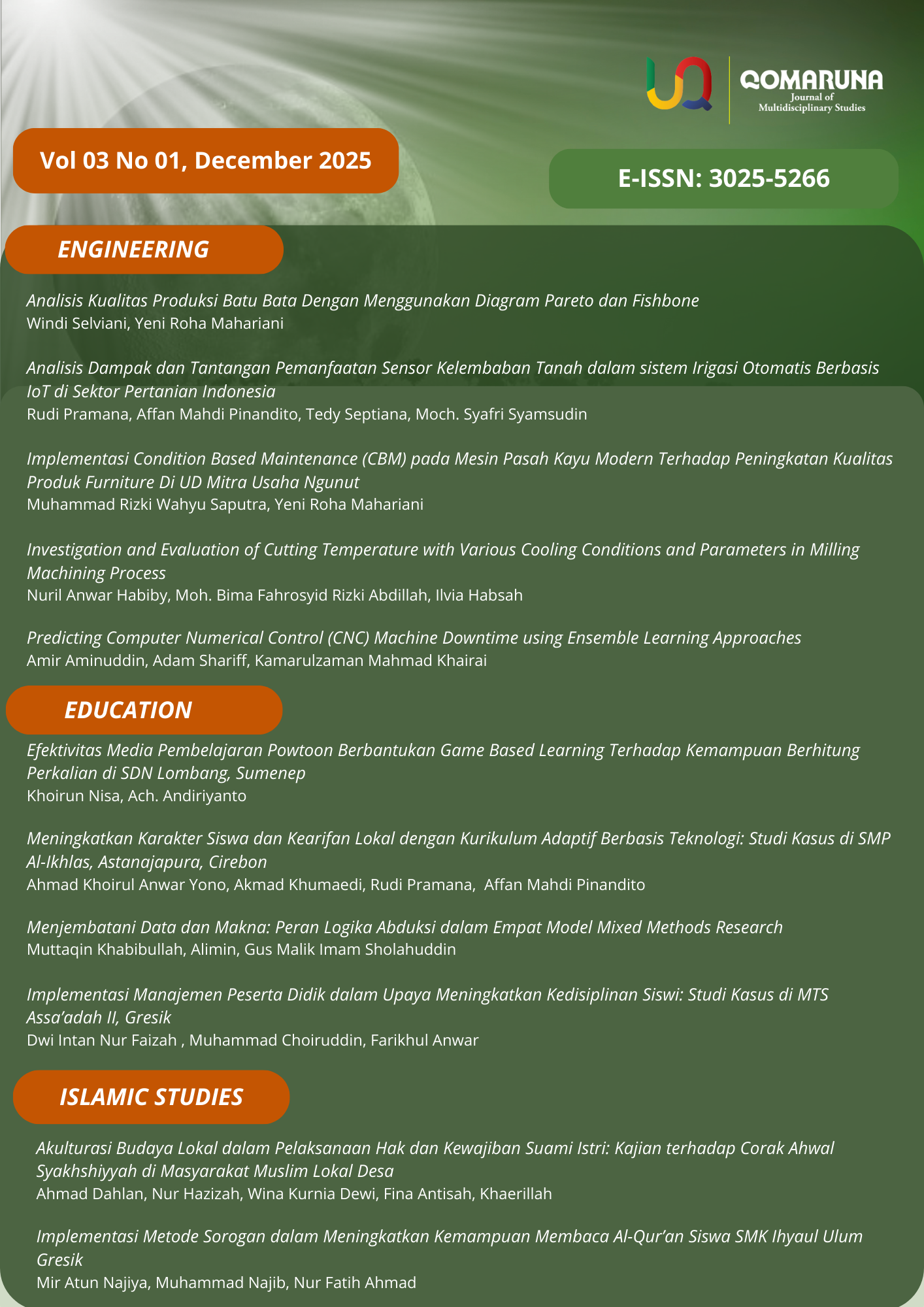
Meningkatkan Karakter Siswa dan Kearifan Lokal dengan Kurikulum Adaptif Berbasis Teknologi: Studi Kasus di SMP Al-Ikhlas, Astanajapura, Cirebon
DOI:
https://doi.org/10.62048/qjms.v3i1.112Keywords:
adaptive curriculum, character strengthening, local wisdom, technology, educationAbstract
The rapid development of digital technology requires educational institutions to continuously adapt their curricula to remain relevant, while simultaneously preserving education’s fundamental role in character development and the preservation of local cultural values. In practice, however, many schools—including pesantren-based schools—still face challenges in meaningfully integrating technology without weakening character education and local wisdom. This study aims to develop and examine the implementation of a technology-based adaptive curriculum that effectively strengthens students’ character while integrating local wisdom. The research was conducted at SMP Al-Ikhlas, Astanajapura District, Cirebon Regency. This study employed a qualitative approach using a case study method. Data were collected through in-depth interviews, participatory observation, and document analysis. The findings indicate that a technology-based adaptive curriculum facilitates learning that aligns with students’ individual needs, interests, learning styles, and learning pace. The curriculum also provides opportunities for value-oriented and local wisdom–based projects and enables more holistic student assessment. Furthermore, technology plays a crucial role in providing interactive platforms and rich learning resources to internalize character values and promote local wisdom in a contextual manner. The implications of this study suggest that a technology-based adaptive curriculum offers both theoretical and practical guidance for curriculum developers, teachers, and policymakers in designing and implementing junior secondary education that is more relevant, adaptive, and rooted in noble cultural values.
References
Al Faruq, U., Arifuddin, N., Ma’arif, A. S., & Husniyah, F. (2025). Implementasi Pendidikan Karakter Berbasis Panca Jiwa di Pesantren: Strategi dan Tantangan dalam Era Digital. Tarbiyatuna: Jurnal Pendidikan Ilmiah, 10(1), 1–18. https://doi.org/10.55187/tarjpi.v10i1.6105
Afdhalurrahman. (2025). Analisis Implementasi Kurikulum Merdeka dalam Meningkatkan kesiapan Siswa Menghadapi Tantangan Era Digital dan Revolusi Industri 4.0 di MTs Tamansiswa Medan. Jurnal Pendidikan, Ilmu Sosial, dan Pengabdian Kepada Masyarakat, 253–262. https://doi.org/10.56832/edu.v5i2.1135
Creswell, J. W. (2015). Educational research: Planning, conducting, and evaluating quantitative and qualitative research (5th ed.). Pearson Education.
Gumelar, D. G., Dwiyanti, D., & Hadiapurwa, R. (2021). Efektivitas Penggunaan Kuis Interaktif Berbasis Video Conference Terhadap Pemahaman Materi Pada Mahasiswa. Inovasi Kurikulum, 18(2), 166–177. https://doi.org/10.17509/jik.v18i2
Haslam, I. R., Khine, M. S., & Saleh, I. M. (Eds.). (2013). Large Scale School Reform and Social Capital Building (0 ed.). Routledge. https://doi.org/10.4324/9780203085110
Hasbullah. (2025). Manajemen Kurikulum Adaptif: Integrasi Pendidikan Karakter dan Digitalisasi Pembelajaran. Jurnal Ilmu Pendidikan, 3(5), 383–393.
Herak, R. (2025). Character Education in the Digital Age: Challenges and Opportunities Amidst Technological Developments. MSJ?: Majority Science Journal, 3(2), 245–252. https://doi.org/10.61942/msj.v3i2.367
Lickona, T. (2012). Educating for character: How our schools can teach respect and responsibility. Bantam Books, New York
Miles, M. B., & Huberman, A. M. (2014). Qualitative data analysis: A methods sourcebook (3rd ed.). SAGE Publications.
Muzakky, R. M. R., Mahmuudy, R., & Faristiana, A. R. (2023). Transformasi Pesantren Menghadapi Era Revolusi Digital 4.0. ALADALAH: Jurnal Politik, Sosial, Hukum Dan Humaniora, 1(3), 241–255. https://doi.org/10.59246/aladalah.v1i3.371
Nurhabibah, S., Sari, H. P., & Fatimah, S. (2025). Pendidikan Karakter di Era Digital: Tantangan dan Strategi dalam Membentuk Generasi Berakhlak Mulia. Jurnal Manajemen Dan Pendidikan Agama Islam, 3(3), 194–206. https://doi.org/10.61132/jmpai.v3i3.1099
Saputra, F. (2024). Pembinaan Karakter Mahasiswa MelaluiPendidikan Agama Islam di Era Digital. Wathan: Jurnal Ilmu Sosial Dan Humaniora, 1(2), 176–188. https://doi.org/10.71153/wathan.v1i2.77
Selwyn, N. (2022). Education and technology: Key issues and debates: International Review of Education, 68(4), 635–636. https://doi.org/10.1007/s11159-022-09971-9
Sugiyono. (2017). Metode Penelitian kualitatif, kuantitatif, dan R&D. Alfabeta, Bandung
Szymkowiak, A., Melovi?, B., Dabi?, M., Jeganathan, K., & Kundi, G. S. (2021). Information technology and Gen Z: The role of teachers, the internet, and technology in the education of young people. Technology in Society, 65, 101565. https://doi.org/10.1016/j.techsoc.2021.101565
Tikkanen, L., Pyhältö, K., Soini, T., & Pietarinen, J. (2017). Primary determinants of a large-scale curriculum reform: National board administrators’ perspectives. Journal of Educational Administration, 55(6), 702–716. https://doi.org/10.1108/JEA-10-2016-0119
Zahira, N., & Nasution, M. I. P. (2024). Perbandingan Perilaku Manajemen Informasi Generasi Z dan Millennials di Era Digital. Jurnal Rumpun Manajemen dan Ekonomi, 2(1), 51–59. https://doi.org/10.61722/jrme.v2i1.3261
Downloads
Published
How to Cite
Issue
Section
License
Copyright (c) 2025 Ahmad Khoiril Anwar, Yono, Akmad Khumaedi, Rudi Pramana

This work is licensed under a Creative Commons Attribution-NonCommercial-ShareAlike 4.0 International License.
Works in this journal are licensed under a Attribution-NonCommercial-ShareAlike 4.0 International.