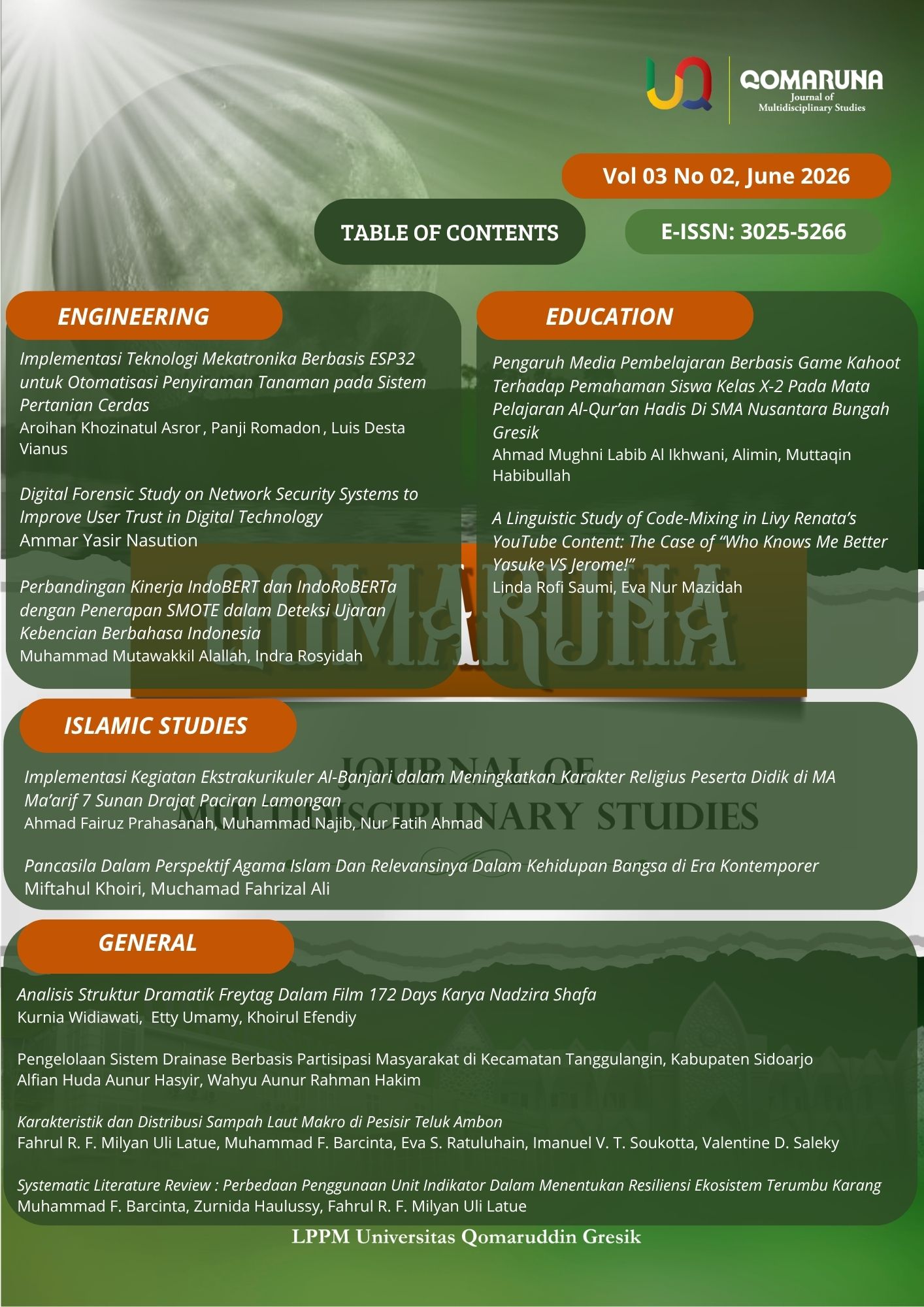
Karakteristik dan Distribusi Sampah Laut Makro di Pesisir Teluk Ambon
DOI:
https://doi.org/10.62048/qjms.v3i2.166Keywords:
macro marine debris, material composition, plastic debris, spatial distribution,, Ambon BayAbstract
Marine debris has become a major environmental concern in coastal areas, particularly in semi-enclosed waters such as Ambon Bay. This study aimed to analyze the characteristics of macro marine debris based on material composition, quantity, mass, and density across four coastal monitoring stations in Ambon Bay. Field surveys were conducted in December 2025 using the shoreline transect method in accordance with the national marine debris monitoring guidelines. Macro debris larger than 2.5 cm was collected, classified by material type, counted, and weighed. Variations in material composition were assessed using the Shannon–Wiener diversity index (H'), while differences in debris mass among stations were analyzed using the non-parametric Kruskal–Wallis test. The results showed that plastic was the dominant material at all stations, resulting in low material diversity. Significant spatial differences in macro marine debris mass were also observed among the stations, with Poka exhibiting the highest debris accumulation, whereas Lateri showed a relatively more diverse material composition than the other stations. These findings indicate that the characteristics of macro marine debris vary spatially across Ambon Bay, highlighting the need for site-specific management strategies to support more effective coastal marine debris control
References
Andrady, A. L., Barnes, P. W., Bornman, J. F. (2022). Oxidation and fragmentation of plastics in a changing environment: From UV-radiation to biological degradation. Science of the Total Environment, 851, Article 158022. https://doi.org/10.1016/j.scitotenv.2022.158022
Barnes, D. K. A., Galgani, F., Thompson, R. C., & Barlaz, M. (2009). Accumulation and fragmentation of plastic debris in global environments. Philosophical Transactions of the Royal Society B: Biological Sciences, 364(1526), 1985–1998. https://doi.org/10.1098/rstb.2008.0205
Bravo, M., Gallardo, M. A., Luna-Jorquera, G., Núñez, P., Vásquez, N., & Thiel, M. (2009). Anthropogenic debris on beaches in the SE Pacific (Chile): Results from a national survey supported by volunteers. Marine Pollution Bulletin, 58(11), 1718–1726. https://doi.org/10.1016/j.marpolbul.2009.06.017
Cole, M., Lindeque, P., Halsband, C., & Galloway, T. S. (2011). Microplastics as contaminants in the marine environment: A review. Marine Pollution Bulletin, 62(12), 2588–2597. https://doi.org/10.1016/j.marpolbul.2011.09.025
Cordova, M. R., & Nurhati, I. S. (2019). Major sources and monthly variations in the release of land-derived marine debris from the Greater Jakarta area, Indonesia. Scientific Reports, 9, Article 18730. https://doi.org/10.1038/s41598-019-55065-2
Critchell, K., & Lambrechts, J. (2016). Modelling accumulation of marine plastics in the coastal zone: What are the dominant physical processes? Estuarine, Coastal and Shelf Science, 171, 111–122. https://doi.org/10.1016/j.ecss.2016.01.036
Dimassi, S. N., Hahladakis, J. N., Yahia, M. N. D., Ahmad, M. I., Sayadi, S., & Al-Ghouti, M. A. (2022). Degradation-fragmentation of marine plastic waste and their environmental implications: A critical review. Arabian Journal of Chemistry, 15(11), Article 104262. https://doi.org/10.1016/j.arabjc.2022.104262
Fauzy, A. (2018). Pengantar statistika nonparametrik. UII Press.
Garcés-Ordóñez, O., Castillo-Olaya, V. A., Granados-Briceño, A. F., Blandón, L. M., & Espinosa
Díaz, L. F. (2020). Plastic litter pollution along sandy beaches in the Colombian Pacific. Marine Pollution Bulletin, 151, Article 110826. https://doi.org/10.1016/j.marpolbul.2019.110826
Jambeck, J. R., Geyer, R., Wilcox, C., Siegler, T. R., Perryman, M., Andrady, A. L., Narayan, R., & Law, K. L. (2015). Plastic waste inputs from land into the ocean. Science, 347(6223), 768–771. https://doi.org/10.1126/science.1260352
Kementerian Lingkungan Hidup dan Kehutanan Republik Indonesia. (2017). Pedoman pemantauan sampah pantai. Kementerian Lingkungan Hidup dan Kehutanan Republik Indonesia.
Kurniawan, S. B., & Imron, M. F. (2019). Seasonal variation of marine debris accumulation in the estuary and coastal area of Bali, Indonesia. Marine Pollution Bulletin, 149, Article 110641. https://doi.org/10.1016/j.marpolbul.2019.110641
Lebreton, L. C. M., van der Zwet, J., Damsteeg, J.-W., Slat, B., Andrady, A. L., & Reisser, J. (2017). River plastic emissions to the world's oceans. Nature Communications, 8, Article 15611. https://doi.org/10.1038/ncomms15611
Lippiatt, S., Opfer, S., & Arthur, C. (2013). Marine debris monitoring and assessment: Recommendations for monitoring debris trends in the marine environment (NOAA Technical Memorandum NOS-OR&R-46). National Oceanic and Atmospheric Administration.
Magurran, A. E. (2004). Measuring biological diversity. Blackwell Publishing.
Purba, N. P., Handyman, D. I. W., Pribadi, T. D., Syakti, A. D., Pranowo, W. S., Harvey, A., & Ihsan, Y. N. (2019). Marine debris in Indonesia: A review of research and status. Marine Pollution Bulletin, 146, 134–144. https://doi.org/10.1016/j.marpolbul.2019.05.057
Shannon, C. E., & Weaver, W. (1949). The mathematical theory of communication. University of Illinois Press.
Syakti, A. D., Hidayati, N. V., Jaya, Y. V., Siregar, S. H., Yude, R., & Suhendy. (2017). Beach macro-litter monitoring and floating microplastic in a coastal area of Indonesia. Marine Pollution Bulletin, 122(1–2), 217–225. https://doi.org/10.1016/j.marpolbul.2017.06.046
Tudor, D. T., & Williams, A. T. (2004). Development of a 'matrix scoring technique' to determine litter sources at a Bristol Channel beach. Journal of Coastal Conservation, 9(1), 119–127. https://doi.org/10.1652/1400-0350(2004)009[0119:DOAMST]2.0.CO;2
United Nations Environment Programme. (2016). Marine plastic debris and microplastics: Global lessons and research to inspire action and guide policy change. United Nations Environment Programme.
United Nations Environment Programme. (2021). From pollution to solution: A global assessment of marine litter and plastic pollution. United Nations Environment Programme.
Downloads
Published
How to Cite
Issue
Section
License
Copyright (c) 2026 Fahrul Rozy Fakaubun, Muhammad Fahrul Barcinta, Milyan Uli Latue, Eva S. Ratuluhain, Imanuel V. T. Soukotta, Valentine D. Saleky

This work is licensed under a Creative Commons Attribution-NonCommercial-ShareAlike 4.0 International License.
Works in this journal are licensed under a Attribution-NonCommercial-ShareAlike 4.0 International.