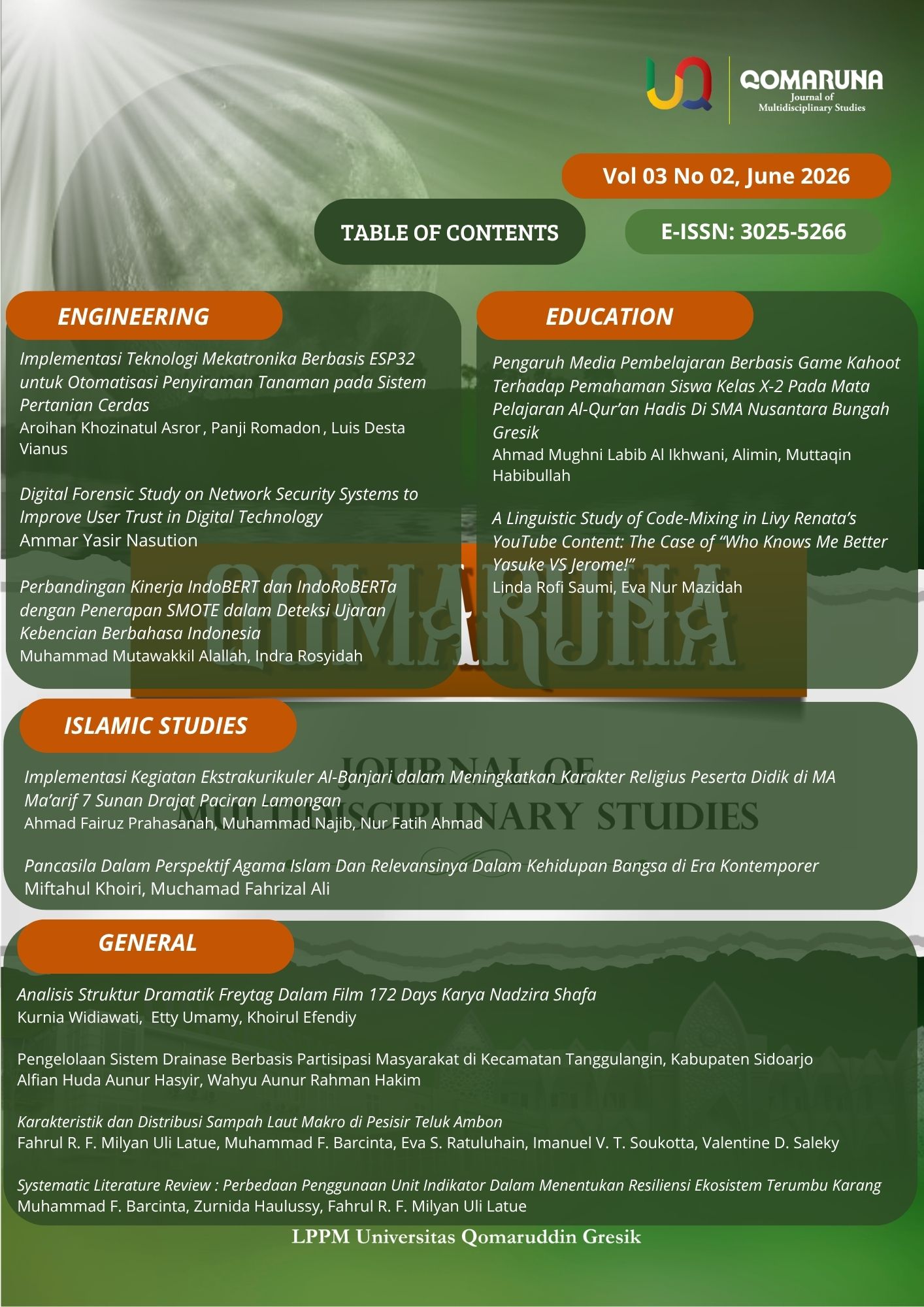
A Linguistic Study of Code-Mixing in Livy Renata’s YouTube Content: The Case of “Who Knows Me Better Yasuke VS Jerome!”
DOI:
https://doi.org/10.62048/qjms.v3i2.141Keywords:
code-mixing, youtube, podcast, content creatorAbstract
The phenomenon of code-mixing has become increasingly common on social media platforms such as YouTube, where creators engage audiences from diverse linguistic and cultural backgrounds. This study addresses the limited research on the specific forms of code-mixing employed by Indonesian YouTubers, focusing on Livy Renata. This study aims to identify and classify the types of code-mixing used in her YouTube content. Using Muysken’s (2000) theoretical framework, this study analyzed language data from a selected video on Livy Renata’s channel. A descriptive qualitative method was applied to examine the occurrences and types of code mixing present. The analysis identified 47 code-mixing instances, comprising 16 insertions (34%), 24 alternations (51%), and 7 congruent lexicalizations (15%). These findings suggest that alternation is the most dominant form of code-mixing in this context, reflecting a flexible linguistic strategy influenced by bilingual interactions. This study provides insights into how Indonesian content creators navigate multilingual communication, contributing to broader sociolinguistic discussions on digital code-mixing practices.
References
Arline Camelia Najuar, Wulan Rahmatunisa, & Marwito Wihadi. (2025). Analysis of Code Mixing on the Youtube Channels of Viral Z-Generation Indonesian Youtubers. Journal of Applied Linguistics, 4(2). https://doi.org/10.52622/joal.v4i2.300
Azyizah, S., & Nuryanti, D. (2023). Code-Switching used by Putri Tanjung and Boy William in Ngobrol Sore Semaunya’s Episode 2. LingPoet: Journal of Linguistics and Literary Research, 4(1). https://doi.org/10.32734/lingpoet.v4i1.9607
Bucholtz, M., & Hall, K. (2005). Identity and interaction: A sociocultural linguistic approach. Discourse Studies, 7(4–5), 585–614. https://doi.org/10.1177/1461445605054407
Creswell., J. W. (2017). Qualitative inquiry and research design: choosing among five approaches - 3rd edition. SAGE Publications Inc.
Holmes, J., & Wilson, N. (2022). An Introduction to Sociolinguistics, Sixth Edition. In An Introduction to Sociolinguistics, Sixth Edition. https://doi.org/10.4324/9780367821852
Miles, M.B & Huberman, A. M. (1994). An expanded sourcebook: Qualitative data analysis (2nd Edition). In Sage Publications (Number 2nd Edition).
Muysken, P. (2003). Bilingual speech: a typology of code-mixing. Journal of Linguistics, 39(3).
Nurhamidah, N., Fauziati, E., & Supriyadi, S. (2018). Code-Switching in EFL Classroom: Is it Good or Bad? Journal of English Education, 3(2). https://doi.org/10.31327/jee.v3i2.861
Pareza, I., & Rosita, N. (2023). Code-Switching Used by Multilingual Person (Jerome Polin) in Nihonggo Mantappu Youtube Video. English Language and Literature, 12(1). https://doi.org/10.24036/ell.v12i1.119862
Profil Livy Renata Lengkap, dari Karier hingga Kekayaan | Orami. (n.d.). Retrieved October 26, 2025, from https://www.orami.co.id/magazine/profil-livy-renata
Radhaswati, I. D. A. A., & Nitiasih, P. K. (2023). Appearances of Code Switching and Code Mixing in Online Conversation. Lingua Scientia, 29(2). https://doi.org/10.23887/ls.v29i2.46109
Stockwell, P. (2002). Sociolinguistics A Resource Book for Students. In System.
Tannen, D., Hamilton, H. E., & Schiffrin, D. (2015). Code-Switching, Identity, and Globalization.
Wardhaugh, Ronald. (2006). An Introduction to Sociolinguistics Fifth Edition. Blackwell Publishing.
Yang, V., & Floris, F. D. (2022). Code-Mixing Analysis in an Introductory Lecture by the Indonesian Minister of Finance, Sri Mulyani Indrawati. K@ta Kita, 10(2). https://doi.org/10.9744/katakita.10.2.261-266
Yim, O., & Clément, R. (2021). Acculturation and attitudes toward code-switching: A bidimensional framework. The International Journal of Bilingualism, 25(5), 1369. https://doi.org/10.1177/13670069211019466
Yuliana, V., & Yanti, N. (2023). Language Attitudes, Shift, Maintenance: A Case Study of Jakartan Chinese Indonesians. Linguistik Indonesia, 41(2), 241–262. https://doi.org/10.26499/li.v41i2.517
Downloads
Published
How to Cite
Issue
Section
License
Copyright (c) 2026 Linda Rofi Saumi, Eva Mazidah

This work is licensed under a Creative Commons Attribution-NonCommercial-ShareAlike 4.0 International License.
Works in this journal are licensed under a Attribution-NonCommercial-ShareAlike 4.0 International.